The Story of Esther: Faith, Courage and God’s Hidden Providence

There is a book in the Bible where God’s name never appears. Not once. No thunder from the mountain, no burning bush, no angelic announcement. Yet if you read the story of Esther carefully, you will find His fingerprints on every page.
That tension—God’s silence and God’s presence—is what makes the Book of Esther one of the most remarkable stories in Scripture. At first glance, it does not look like a miracle story. It looks like a young woman caught in an impossible situation, living in a foreign land and facing a decision that could cost her everything.
But that is precisely the point. The story of Esther shows how God can work through ordinary people, unexpected circumstances, and events that seem insignificant at the time.
Esther was a young Jewish woman who became queen of Persia. When a powerful official named Haman plotted to destroy the Jewish people, she found herself at the center of a crisis that would change the course of history.
Before we explore the lessons of Esther’s faith and courage, let’s begin with a simple question: who was Esther in the Bible?
Who Was Esther in the Bible?
Before Esther was Queen Esther, she was an orphan.
Her Hebrew name was Hadassah, meaning “myrtle.” After her parents died, she was raised by her cousin Mordecai, a Jewish man living in the Persian capital of Susa. This was during the Jewish exile, when many Jews lived scattered throughout the Persian Empire, far from their homeland.
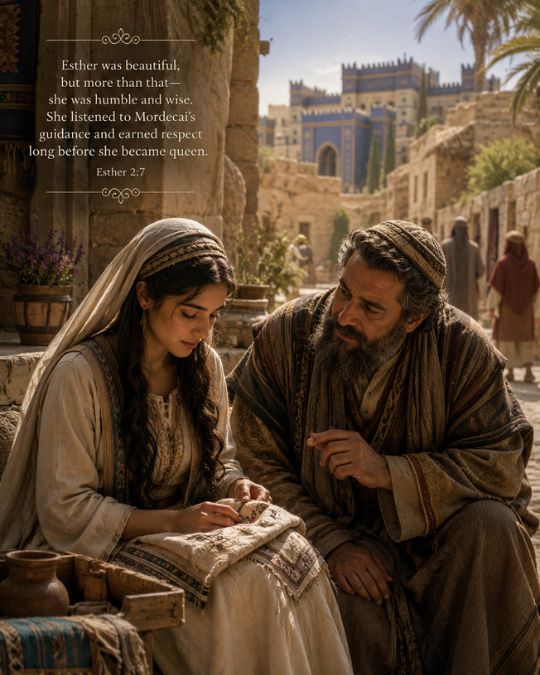
The story of Esther begins not with a queen, but with a young Jewish woman living a quiet life in a foreign land. Scripture tells us she was beautiful, but it also reveals a woman marked by humility and wisdom. She listened to Mordecai’s guidance and earned the respect of those around her long before she entered the royal palace.
When we ask who Esther was in the Bible, the answer is surprisingly ordinary. She was not a prophet, a judge, or a military leader. She was a young woman shaped by loss, faith, and circumstances beyond her control.
Yet God would place her in a position few could have imagined. Esther became queen to King Ahasuerus (Xerxes I), ruler of one of the largest empires in the ancient world. What began as the quiet life of an orphan would eventually become one of the most important stories of courage and deliverance in Scripture.
The Story of Esther: A Complete Summary
A Queen Is Chosen
The story begins when King Ahasuerus hosts a lavish banquet and summons Queen Vashti to appear before his guests. When she refuses, the king removes her from her position, leaving the Persian throne without a queen.

A search is launched across the empire to find a successor. Among the young women brought to the palace is Esther, a Jewish orphan raised by her cousin Mordecai. Under the care of Hegai, the king’s official, Esther quickly gains favour with those around her. When she is eventually presented to the king, he chooses her above all the others and crowns her queen of Persia.
At the time, Esther could not have known why these events were unfolding. She had simply gone from an ordinary life in Susa to the royal palace. But her new position would soon place her at the center of a crisis that threatened the future of her people.
Mordecai Uncovers a Plot
Not long after Esther became queen, Mordecai overheard two of the king’s officials plotting to assassinate King Ahasuerus. He reported the conspiracy through Esther, who informed the king in Mordecai’s name. After an investigation confirmed the plot, the conspirators were executed.
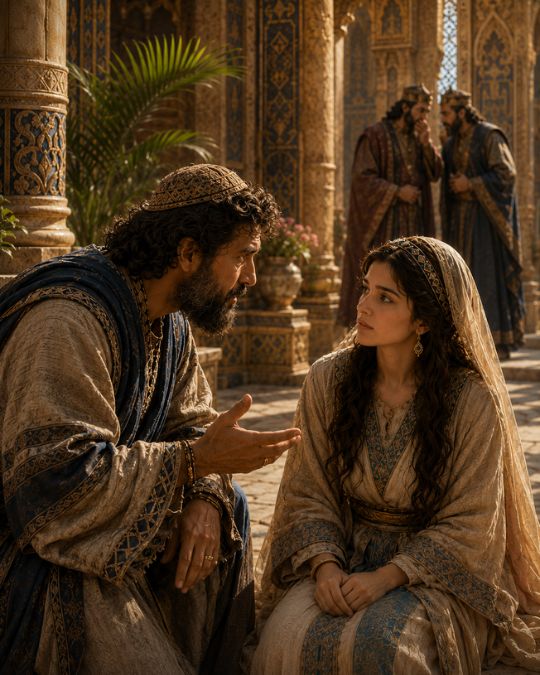
The event was recorded in the royal chronicles, and life moved on. At the time, it seemed like a minor detail.
Yet this forgotten act of loyalty would later play a crucial role in the deliverance of the Jewish people.
Haman’s Pride and Evil Plan
The next major figure in the story is Haman.
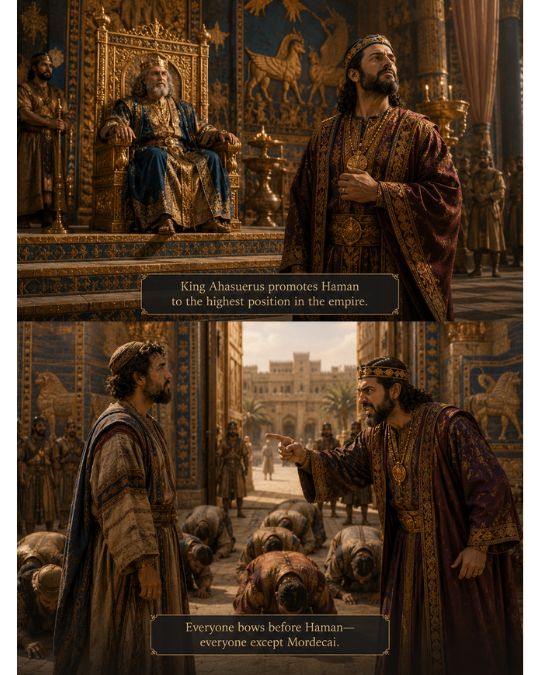
King Ahasuerus promotes him to the highest position in the empire, second only to the king himself. As Haman passes through the palace gate, everyone bows before him—everyone except Mordecai.
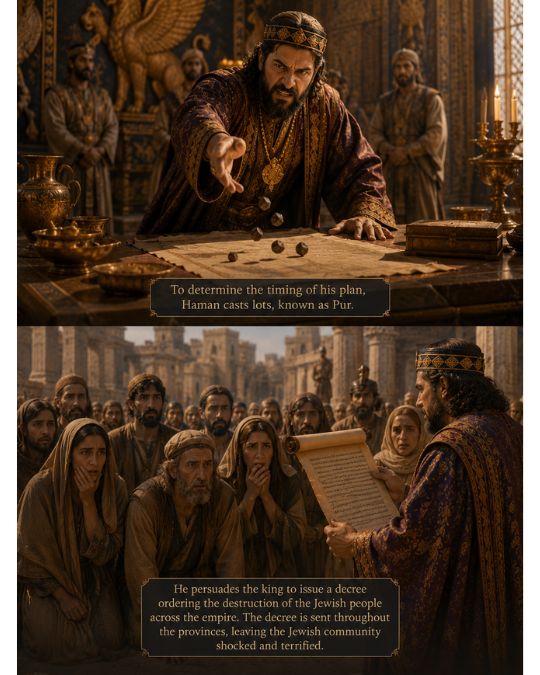
Haman is furious. When he learns that Mordecai is Jewish, his anger grows into something much darker. Rather than seeking revenge on one man, he decides to destroy the entire Jewish population throughout the Persian Empire.
To determine the timing of his plan, Haman casts lots, known as Pur. He then persuades the king to issue a decree ordering the destruction of the Jewish people across the empire. The decree is sent throughout the provinces, leaving the Jewish community shocked and terrified.
What began as one man’s wounded pride had become a threat to an entire nation.
Mordecai’s Challenge to Esther
When the decree reaches the Jewish communities throughout the empire, mourning breaks out. Mordecai tears his clothes, puts on sackcloth and ashes, and goes to the palace gate in grief. When Esther learns what has happened, she sends messengers to discover the cause.
Mordecai urges Esther to go before the king and plead for her people. But Esther hesitates. Persian law stated that anyone who approached the king without being summoned could be put to death—even the queen. She had not been called into the king’s presence for thirty days.
Mordecai responds with one of the most memorable challenges in Scripture:
“Do not think that because you are in the king’s house you alone of all the Jews will escape. For if you remain silent at this time, relief and deliverance for the Jews will arise from another place, but you and your father’s family will perish. And who knows but that you have come to your royal position for such a time as this?” — Esther 4:13–14 (NIV)
This is the turning point of the entire Esther Bible story. Mordecai does not flatter her. He does not promise safety. He simply names the reality: this is the moment she was placed here for. Comfort is no longer the option.
Esther Risks Her Life
Esther responds by asking the Jewish people in Susa to fast for her for three days, neither eating nor drinking. She and her attendants will do the same. Then she sends a message back to Mordecai:
“When this is done, I will go to the king, even though it is against the law. And if I perish, I perish.” — Esther 4:16 (NIV)
With those words, Esther makes her decision.
On the third day, she puts on her royal robes and enters the inner court of the palace. The king sees her and extends his golden sceptre, the sign that she has been accepted. Esther’s life is spared, but the danger is not over. Rather than making her request immediately, she invites the king and Haman to a banquet, setting in motion the events that will soon change everything.
The King’s Sleepless Night
Esther invites the king and Haman to a banquet. When the king asks what she wants, Esther delays her request and instead invites them both to a second banquet the following day.
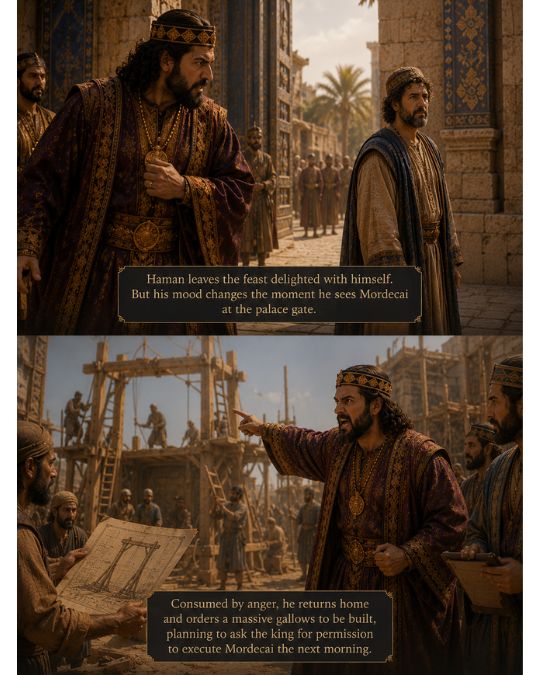
Haman leaves the feast delighted with himself. But his mood changes the moment he sees Mordecai at the palace gate. Consumed by anger, he returns home and orders a massive gallows to be built, planning to ask the king for permission to execute Mordecai the next morning.
That night, however, the king cannot sleep. As the royal records are read to him, he discovers that Mordecai was never rewarded for uncovering the assassination plot years earlier.
The next morning, Haman arrives at court intending to request Mordecai’s execution. Before he can speak, the king asks him what should be done for a man the king wishes to honor. Assuming the honor is meant for him, Haman describes an elaborate public celebration.
To his shock, the king commands him to do exactly that for Mordecai.
For the first time, the tide begins to turn. The man Haman planned to execute is publicly honored instead, and the plans he carefully built begin to unravel.
Esther Exposes Haman
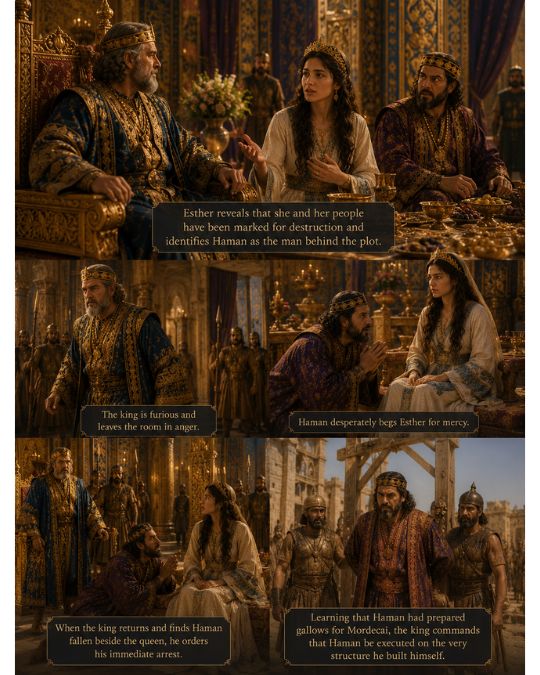
At the second banquet, the king again asks Esther what she wants. This time she speaks plainly. She reveals that she and her people have been marked for destruction and identifies Haman as the man behind the plot.
The king is furious. He leaves the room in anger while Haman desperately begs Esther for mercy. When the king returns and finds Haman fallen beside the queen, he orders his immediate arrest. Learning that Haman had prepared gallows for Mordecai, the king commands that Haman be executed on the very structure he built himself.
The downfall of Haman is complete. The man who sought to destroy God’s people is destroyed by his own scheme.
Esther Saves Her People
Although Haman was gone, the original decree remained in effect. Under Persian law, it could not simply be revoked.
Esther again approached the king and pleaded for her people. In response, a new decree was issued, giving the Jews throughout the empire the right to defend themselves against anyone who attacked them.
When the appointed day arrived, the Jewish people prevailed over their enemies. What had begun as a plan for their destruction ended in their deliverance.
Mordecai was elevated to a position of honour, and the mourning that had spread through the Jewish communities was turned into celebration.
The Feast of Purim Begins
In celebration of their deliverance, Mordecai and Esther establish the Feast of Purim, named after the Pur, or lot, that Haman cast when planning the destruction of the Jewish people.
The festival became an annual reminder of how God preserved His people during a time of great danger. To this day, Jewish communities around the world continue to observe Purim and remember the events recorded in the Book of Esther.
With the crisis resolved and God’s people delivered, the story closes with celebration, gratitude, and remembrance.
Major Themes in the Story of Esther
God’s Providence Even When He Seems Silent
One of the most striking features of the Book of Esther is that God’s name never appears. There are no miracles, prophecies, or divine speeches. Yet His hand can be seen throughout the story.
Esther becomes queen at exactly the right time. Mordecai uncovers a plot against the king. A sleepless night leads to a forgotten act of loyalty being remembered. What appears to be coincidence after coincidence ultimately reveals God’s providence at work.
I think this is one of the most comforting truths in Esther. God does not always announce His presence, but that does not mean He is absent. Even in seasons when He seems silent, He is still working behind the scenes to accomplish His purposes.
Courage Is Not the Absence of Fear
Esther knew the danger she faced. Approaching the king without an invitation could cost her life. Yet she chose to act anyway.
Her words, “If I perish, I perish,” are not the words of someone without fear. They are the words of someone who decided that obedience mattered more than safety.
Esther reminds us that biblical courage is not the absence of fear. It is trusting God enough to do what is right even when the outcome is uncertain.
God Uses Ordinary People
Before she became queen, Esther was an orphan living in exile. Mordecai was a minor official sitting at the city gate. Neither appeared to be an obvious candidate for a major role in God’s plan.
Yet throughout Scripture, God often works through ordinary people who are willing to be faithful where He has placed them. Esther did not choose her circumstances, but she chose faithfulness within them.
That same pattern encourages us today. God is not limited by our background, abilities, or position. He simply calls us to be faithful with what He has given us.
Pride Leads to Destruction
The contrast between Haman and Esther runs throughout the story. Haman uses his position to pursue power, recognition, and revenge. Esther uses her position to serve and protect others.
As Haman’s pride grows, it ultimately leads to his downfall. The very gallows he builds for Mordecai become the instrument of his own execution.
“God opposes the proud but shows favour to the humble.” — James 4:6b (NIV)
The Book of Esther illustrates this verse long before it was written. Haman’s pride builds the very gallows he will hang on. Esther’s humility and service become the foundation of a national deliverance.
Frequently Asked Questions About the Story of Esther
What Is the Main Story of Esther in the Bible?
The story of Esther follows a young Jewish woman who became queen of Persia and risked her life to save her people from destruction. When a royal official named Haman plotted to eliminate the Jewish population throughout the empire, Esther courageously approached King Ahasuerus and exposed the scheme. Through her actions, God delivered His people and turned a planned tragedy into a victory.
Did the King Actually Love Esther?
The Book of Esther tells us that King Ahasuerus loved Esther more than all the other women and chose her to be queen (Esther 2:17). While the Bible does not explore the depth of their relationship in detail, the king consistently showed her favor. He extended his golden scepter when she approached him uninvited and repeatedly offered to grant her requests, actions that ultimately helped Esther save her people.
What Are 5 Lessons From the Book of Esther?
The Book of Esther teaches several important lessons:
- God is at work even when He seems silent.
- Courage often requires acting despite fear.
- God can use ordinary people for extraordinary purposes.
- Pride leads to destruction, while humility brings honor.
- Faithfulness in the right moment can impact many lives.
These lessons continue to encourage believers to trust God’s providence and remain faithful in difficult circumstances.
What Does Esther 4:14 Teach Us?
Esther 4:14 contains Mordecai’s famous challenge: “And who knows but that you have come to your royal position for such a time as this?” The verse teaches that God often places people in specific situations for a purpose. Rather than viewing our circumstances as random, Christians can trust that God may use their position, opportunities, and influence to accomplish His purposes and serve others.
For Such a Time as This
The story of Esther is, at its heart, a story about God’s faithfulness in hidden places.
A Jewish orphan becomes a Persian queen. An act of loyalty is recorded and forgotten. A sleepless night changes the course of events. A woman walks toward a throne she was not summoned to and says, “If I perish, I perish.”
None of it looks miraculous on the surface. Yet when we step back and see the whole picture, God’s hand is everywhere.
I have known people who were convinced God had gone quiet because they could not see what He was doing. Esther reminds us that God’s silence is not the same as His absence. The Book of Esther does not promise that God will always announce Himself clearly, but it does show that He is always at work.
Esther’s story is not just about a queen who saved her people. It is about a faithful God who worked through ordinary people and ordinary circumstances to accomplish His purposes.
And perhaps that is the question Esther leaves with us: will we be faithful where God has placed us today?