Sermon on Depression: When the Light Goes Out

Good morning, church family. Have you ever walked through a season when everything felt heavy?
You still went to work. You still smiled when people asked how you were doing. You still said, “I’m fine.” But inside, you felt exhausted, numb, or overwhelmed.
Maybe you’ve even wondered, “Does God still see me when I feel this low?”
Today, we’re talking about something Christians sometimes struggle to talk about openly: depression.
Depression is not simply having a bad day or feeling disappointed when something goes wrong. For some people, the darkness can feel deep and persistent, affecting the mind, body, emotions, relationships, and even the way they experience their faith.
And this is the truth I want us to hold onto today:
God is present in the darkness, even when we cannot feel Him.
The Bible doesn’t hide the darkest moments of God’s people. It shows us faithful men and women who became exhausted, afraid, discouraged, and overwhelmed.
One of the clearest examples is Elijah.
In 1 Kings 19, Elijah goes from one of the greatest victories of his life to sitting alone in the wilderness, telling God that he has had enough.
And what God does next tells us something important about how He meets us in our lowest moments.
So let’s turn to 1 Kings 19:3–4.
Depression Is Real, and God’s People Experience Deep Despair
Elijah had just witnessed an extraordinary display of God’s power on Mount Carmel. Yet after Queen Jezebel threatened his life, everything changed.
“Elijah was afraid and ran for his life… He came to a broom bush, sat down under it and prayed that he might die. ‘I have had enough, Lord,’ he said.” — 1 Kings 19:3–4 (NIV)
This is Elijah—a faithful prophet who had witnessed God’s power firsthand. Yet here he is exhausted, afraid, isolated, and overwhelmed.
The Bible does not diagnose Elijah with clinical depression, but his story shows us something important: deep emotional suffering is not proof that someone has lost their faith.
And notice how God responds.
He doesn’t begin by rebuking Elijah or questioning his faith. He allows him to sleep and provides food and water before leading him forward.
There is compassion in that response.
For Christians struggling with depression, Elijah’s story reminds us that feeling exhausted or overwhelmed does not make us failures in God’s eyes. We do not have to pretend everything is okay in order to come before Him.
Psalm 42 expresses that honesty beautifully:
“Why, my soul, are you downcast? Why so disturbed within me? Put your hope in God, for I will yet praise him, my Savior and my God.” — Psalm 42:5 (NIV)
Faith does not require us to hide our darkest feelings. We can bring them honestly before God and continue to place our hope in Him.
Key Takeaways:
- Faithful people can experience profound fear, exhaustion, discouragement, and despair.
- Scripture does not diagnose Elijah with clinical depression, but his story can speak powerfully to people walking through dark seasons.
- God responds to Elijah with care rather than immediate condemnation.
- Struggling emotionally does not automatically mean that someone has weak faith.
- We can speak honestly to God about what we are experiencing.
Amen.

God Meets Us in Our Darkness with Presence, Not Pressure
Later in 1 Kings 19, Elijah reaches Mount Horeb and tells God how alone he feels:
“I am the only one left, and now they are trying to kill me too.” — 1 Kings 19:10 (NIV)
But Elijah was not actually alone. God would later tell him that thousands in Israel had remained faithful.
Then something remarkable happens. A powerful wind tears through the mountain, followed by an earthquake and a fire. Yet the Lord is not in them. Afterward comes a gentle whisper (1 Kings 19:11–12).
In one of Elijah’s darkest moments, God makes His presence known.
That speaks powerfully to seasons of depression because God’s presence does not depend on our ability to feel Him. There may be days when prayer feels difficult, Scripture doesn’t stir the emotions it once did, and God seems distant. That feeling of distance does not mean He has abandoned us.
Jesus gives a similar invitation in Matthew 11:
“Come to me, all you who are weary and burdened, and I will give you rest.” — Matthew 11:28 (NIV)
Notice who Jesus invites: the weary and burdened.
We don’t have to get ourselves together before coming to Christ. We don’t have to hide our exhaustion or manufacture happiness. We can come to Him as we are.
When you cannot feel God’s presence, hold onto what Scripture tells you about His character. The God who met Elijah in his exhaustion is still the God who draws near to the weary today.
Walking Forward Means Accepting Help and Taking Small Steps
Before Elijah leaves Mount Horeb, God tells him something crucial:
“Yet I reserve seven thousand in Israel—all whose knees have not bowed down to Baal.” — 1 Kings 19:18 (NIV)
In other words: “Elijah, you’re not alone. You’re not the only one left.”
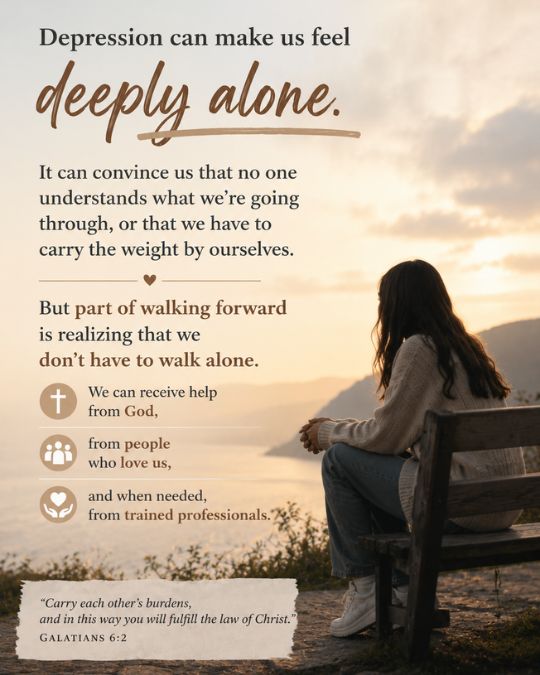
Depression can make us feel deeply alone. It can convince us that no one understands what we’re going through, or that we have to carry the weight by ourselves.
But part of walking forward is realizing that we don’t have to walk alone. We can receive help from God, from people who love us, and when needed, from trained professionals.
Let me be practical here, because sometimes we need concrete steps, not just theological concepts.
First, acknowledge when you need help.
There’s no shame in this. You wouldn’t try to set your own broken leg, would you? Mental health is health. If you’re experiencing persistent depression or struggling to function in everyday life, seeking professional support can be an important step.
And I’m going to say something that some Christians need to hear: taking prescribed medication for depression is not automatically a sign of weak faith.
We don’t normally tell someone with a physical illness that seeking medical treatment means they aren’t trusting God enough. We shouldn’t place that burden on someone struggling with their mental health either.
Dr. Kathryn Butler, a Christian physician, has written about this tension among believers, including the concern that using medication somehow demonstrates inadequate faith. For some people, professional treatment may include counseling, medication, or both.
Seeking appropriate help and trusting God do not have to be opposites.
Second, stay connected even when you want to isolate.
This can be hard. When you’re depressed, being around people may feel exhausting. But you don’t have to pretend you’re okay or show up with a fake smile.
Start small.
Call one friend. Send one honest text. Talk to someone you trust at church. Let another person know, “I’m struggling right now.”
Sometimes one of the bravest things we can do is allow someone else to walk beside us.
Third, do the next small thing.
Not the next big thing. Not the thing that fixes everything.
Just the next small, manageable step.
- Can you get out of bed? Do that.
- Can you take a shower? Do that.
- Can you eat something? Do that.
- Can you step outside for a few minutes? Do that.
- Can you read one verse of Scripture? Start there.
“Even though I walk through the valley of the shadow of death, I will fear no evil, for you are with me.” — Psalm 23:4 (ESV)
Notice the word walk.
You don’t have to run through the valley. Sometimes you simply keep taking the next step.
And you don’t walk alone: God is with you.
Fourth, hold onto what you know, even when you can’t feel it.
There may be days when you can’t sense God’s presence. Worship may feel empty. Prayer may feel difficult. The words of Scripture may not immediately change how you feel.
In those moments, hold onto what you know about God.
- You know God is faithful—hold onto that.
- You know He loves you—hold onto that.
- You know He has promised to remain with His people—hold onto that.
The Apostle Paul writes:
“Praise be to the God and Father of our Lord Jesus Christ, the Father of compassion and the God of all comfort, who comforts us in all our troubles, so that we can comfort those in any trouble with the comfort we ourselves receive from God.” — 2 Corinthians 1:3–4 (NIV)
And there is hope even here.
The comfort we receive in our darkest seasons can someday become the comfort we offer to someone else walking through theirs.
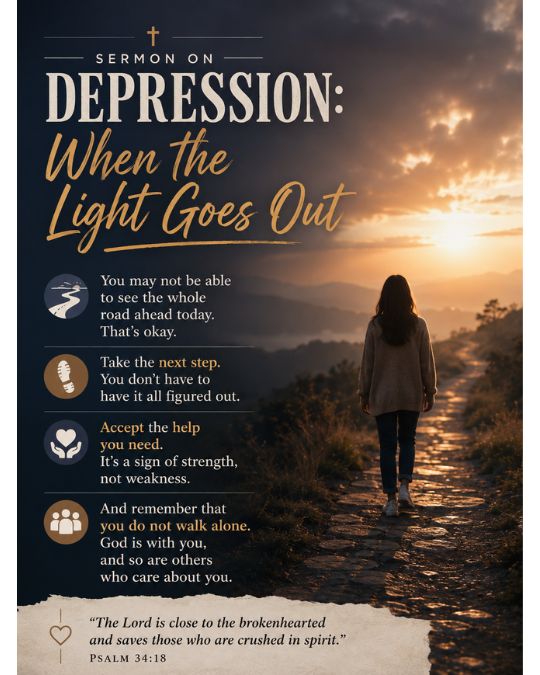
You may not be able to see the whole road ahead today. That’s okay. Take the next step, accept the help you need, and remember that you do not walk alone.
How Can Christians Support Someone with Depression?
Maybe you’re not the person struggling with depression. Maybe you’re reading this because someone you love is.
If that’s you, remember this: you don’t have to have all the answers to be helpful.
One of the most important things you can do is simply be present without trying to fix everything.
Avoid quick answers like “Just have more faith,” “Think positively,” or “You just need to pray more.” Even when those words are well-intended, they can leave someone feeling as though their struggle is a spiritual failure.
Instead, listen.
Let them talk without immediately trying to solve the problem. Check in on them, especially when they begin pulling away. Sit with them. Pray with them if they are comfortable with it. Sometimes a quiet, faithful presence can mean more than a hundred pieces of advice.
And when the struggle becomes too heavy, encourage them to seek appropriate professional help. Offer to help them find a counselor or doctor. If they’re nervous about making that first appointment, perhaps sit beside them while they make the call. Remind them that asking for help is not something to be ashamed of.
Encourage them to stay connected to healthy community as well.
Depression often makes people want to withdraw, but we were never meant to carry every burden alone. A church community, small group, trusted friends, or family can provide a safe place to talk, pray, receive encouragement, and release some of the emotional weight they’ve been carrying.
You don’t need to force them into a crowded room or expect them to suddenly become social again. Start small. Invite them for coffee. Take a walk together. Ask them to sit with you at church. Keep reaching out even when they don’t always have the energy to respond.
Galatians 6:2 tells us:
“Carry each other’s burdens, and in this way you will fulfill the law of Christ.”
Sometimes that’s exactly what loving someone through depression looks like.
You may not be able to take away their pain. You may not know the perfect words to say. But you can remind them, through your presence, that they do not have to carry it alone.
The God Who Sees in the Dark
Church, let me bring this home. Remember our theme: God is present in the darkness, even when we cannot feel Him.
Depression is real, and the Bible does not hide the reality of deep emotional suffering. Struggling does not mean you are faithless. It does not mean God has abandoned you. And it does not mean you have to pretend everything is okay.
Here’s the good news: The same God who met Elijah under the broom tree meets us in our darkest seasons. The God who came near to Elijah in a gentle whisper is still near to the weary today. And the same Jesus who invited the weary and burdened to come to Him still gives that invitation.
You are not alone. You are not beyond God’s reach. You are not disqualified from His love.
And if you’ve never personally walked through depression, remember that someone you love may be walking through it right now. Your spouse. Your child. Your friend. Your coworker. They may not need you to fix everything. They may simply need you to listen, to stay, to pray, and to walk beside them without judgment.
The valley can be dark. Sometimes the road through it can be longer than we expected.
But we do not have to walk it alone.
There is hope. There is help. And even in the darkness, God is still present.
Amen.
Let’s pray.
Father, we come to You weary and burdened. Some of us are walking through valleys so dark we can barely see the path ahead. Meet us there. Whisper to us when the noise is too loud. Hold us when we don’t have the strength to hold onto You. Give us courage to ask for help, wisdom to accept it, and grace to take the next small step. For those supporting loved ones with depression, give them patience, compassion, and endurance. We trust that You are present in our darkness, even when we cannot feel You. In Jesus’s name, Amen.
References
Butler, Kathryn. “Scrambling for the Light: Christian Depression and the Use of Medication.” Desiring God, 13 Oct. 2024, https://www.desiringgod.org/articles/scrambling-for-the-light.