Biblical Meaning of Number 13: Rebellion, Pride, and Humanity’s Resistance to God

Every so often, a number captures people’s imagination. The number 13 is one of those numbers. Hotels skip the thirteenth floor. Builders quietly renumber the thirteenth unit. Airports tuck the gate away as if hoping no one notices. Some people will not make a significant decision on the thirteenth of the month. The curiosity — and sometimes the fear — is real.
But where does it come from? And more importantly, what, if anything, does the Bible actually say about it?
Let me be clear from the outset: this is not an article about angel numbers. It is not about superstition, luck, or hidden mystical codes. If you have come looking for a fortune-teller’s reading of the number 13, you will not find one here. The Bible does not operate that way, and neither do we.
What you will find is something far more interesting: a careful look at the way the number 13 surfaces in Scripture and what those appearances reveal about a consistent, sobering theme — the theme of human rebellion, pride, and our tendency to resist God’s authority.
In short: in the Bible, the number 13 is commonly associated with rebellion, human pride, and resistance against God’s authority. Not because the number itself carries a curse, but because the biblical narrative places it, time and again, at moments when humanity chose its own way over God’s.
Let us look carefully at what Scripture actually shows us.
What Does the Number 13 Mean in the Bible?
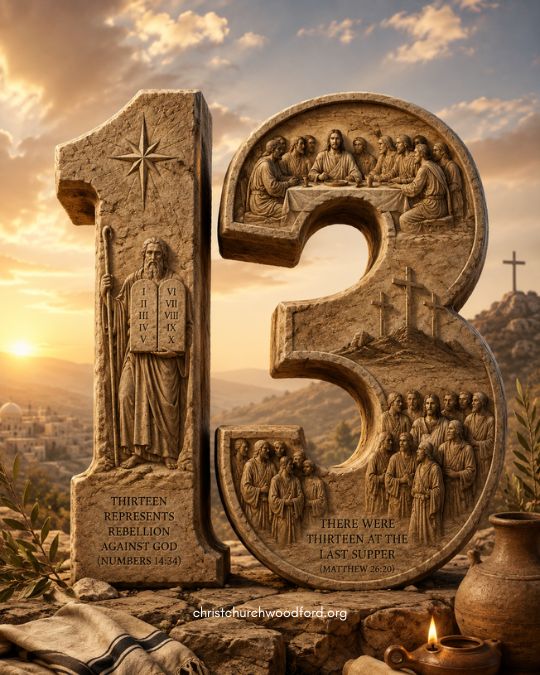
Biblical numerology is not a system of hidden codes or mystical powers. Numbers in Scripture are not magic. They are patterns — recurring images that the Holy Spirit weaves through the biblical narrative to communicate meaning and reveal truth. Just as seven consistently points to divine completeness and three to confirmation and fullness, thirteen carries its own recurring weight.
The main themes associated with the number 13 in the Bible are: rebellion, lawlessness, pride, and disorder. The biblical significance of 13 is not arbitrary. It grows out of specific historical events recorded in the text, events where human beings turned from God, elevated themselves, and embraced a posture of self-rule.
Understanding the Bible meaning of number 13 requires us to read it the same way we read any other biblical symbol — not by importing meaning from outside the text, but by letting Scripture interpret Scripture.
Why Is Number 13 Associated With Rebellion?
To understand why thirteen is connected to rebellion, it helps to understand what twelve represents.
In Scripture, twelve consistently symbolises divine order and governmental completeness. There were twelve tribes of Israel — the people of God structured and organised under his covenant design. There were twelve apostles — the foundation stones of the new covenant community. Twelve represents God’s arrangement of things, his deliberate, ordered, authoritative framework.
Thirteen, then, symbolically moves beyond that established order. It is the number that, in key biblical moments, marks the step past God’s boundary — the assertion of human will against divine structure. Where twelve speaks of what God has set in place, thirteen appears at moments when people push beyond it.
This is not a mechanical rule. The Bible never declares the number itself to be rebellious. But the pattern is striking enough that it deserves serious attention. Wherever thirteen appears in Scripture, we would do well to ask: who is asserting themselves against God here, and what are the consequences?
Biblical Occurrences Connected to Number 13
Let us look at the specific passages where the number thirteen appears and examine what is happening in the narrative.
Genesis 14:4 — “In the Thirteenth Year They Rebelled”
The first mention of thirteen in the Bible is also one of the clearest.
“For twelve years they had served Chedorlaomer, but in the thirteenth year they rebelled.” — Genesis 14:4 (ESV)
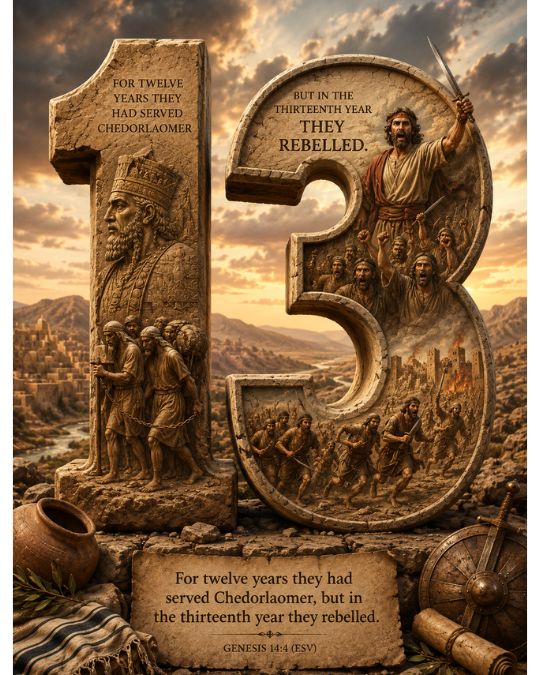
The connection is striking. The very first appearance of the number 13 in Scripture arrives in the context of open rebellion. Twelve years of submission are followed by a thirteenth year marked by revolt against established authority.
This first mention helps establish the biblical meaning of number 13 as a symbolic picture of rebellion, self-rule, and humanity stepping outside established order. The pattern introduced here echoes throughout Scripture.
Ishmael Was Circumcised at 13 Years Old
The second major occurrence appears in Genesis 17, in the story of Abraham, Hagar, and Ishmael.
“And Ishmael his son was thirteen years old when he was circumcised in the flesh of his foreskin.” — Genesis 17:25 (ESV)
Ishmael was born after Abraham and Sarah attempted to fulfil God’s promise through human effort rather than waiting on God’s timing. In Scripture, Ishmael becomes a symbolic contrast to Isaac — flesh versus promise, human striving versus divine faithfulness.
Paul later highlights this distinction in Galatians 4:23, describing Ishmael as born “according to the flesh” while Isaac was born through promise.
The biblical significance of 13 here is connected to humanity attempting to accomplish through its own strength what God intended to accomplish by grace. Ishmael’s story reflects a recurring biblical pattern: people stepping ahead of God instead of trusting him fully.
How the Themes Associated With 13 Reappear Throughout Scripture
While these passages do not directly mention the number 13, they reflect the same biblical themes associated with it: rebellion, pride, and resistance to God’s authority. Throughout Scripture, humanity repeatedly attempts to step outside God’s order and establish its own way instead.
The Tower of Babel
Genesis 11 records one of the clearest pictures of organised human pride in the Bible. Humanity gathered together with a single ambition: “Let us make a name for ourselves” (Genesis 11:4).
“Then they said, ‘Come, let us build ourselves a city and a tower with its top in the heavens, and let us make a name for ourselves.’” — Genesis 11:4 (ESV)
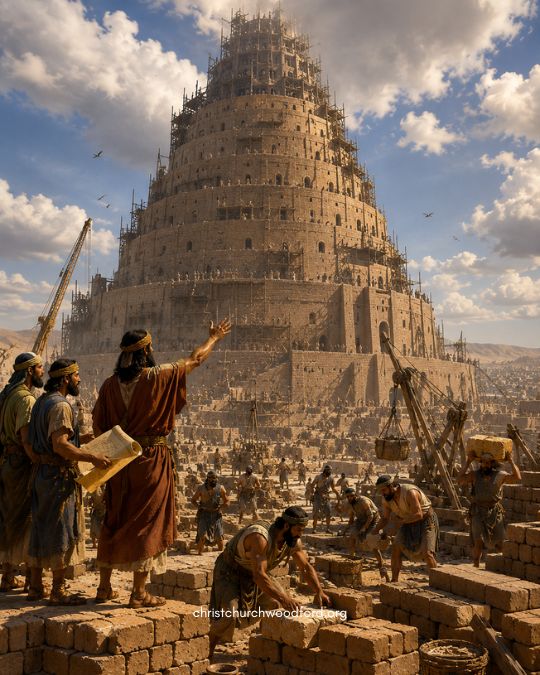
The tower of Babel represents humanity attempting to build greatness apart from God. The issue was not architecture but self-rule — a civilisation organised around human glory rather than divine authority. The same spirit seen in Genesis 14:4 appears here again: humanity pushing beyond the order God established in pursuit of its own name and power.
God scattered the people and confused their language, restraining a rebellion that would only have grown deeper. The themes associated with the biblical meaning of number 13 — pride, disorder, and resistance to God’s authority — are vividly reflected in Babel.
Korah’s Rebellion
Numbers 16 records Korah’s rebellion against Moses and Aaron, the leaders God had appointed over Israel.
“They assembled themselves together against Moses and against Aaron…” — Numbers 16:3 (ESV)
Korah presented his rebellion as fairness and equality, but underneath was a rejection of God’s established authority. This is one of the Bible’s clearest warnings about spiritual pride. Rebellion rarely presents itself openly. It often disguises itself as wisdom, justice, or personal freedom while ultimately resisting God’s design.
The biblical significance of 13 repeatedly points toward this same pattern: humanity asserting its own order instead of trusting the one God has established.
Israel’s Wilderness Rebellion
The wilderness generation experienced God’s deliverance firsthand. They saw miracles in Egypt, crossed the Red Sea, and were sustained daily in the desert — yet they repeatedly complained, doubted, and resisted God.
“Many times he delivered them, but they were rebellious in their purposes…” — Psalm 106:43 (ESV)
Israel’s wilderness rebellion reveals how deeply rooted human pride can be. The issue was never merely hardship in the desert. It was the refusal to trust God’s timing, provision, and leadership.
This same spiritual pattern appears throughout the Bible meaning of number 13: people stepping outside God’s order, choosing self-rule over trust, and creating disorder through rebellion.
Is Number 13 Evil in the Bible?
This is one of the most common questions people bring to this topic. Is 13 an evil number in Christianity? The clear, honest answer is: no.
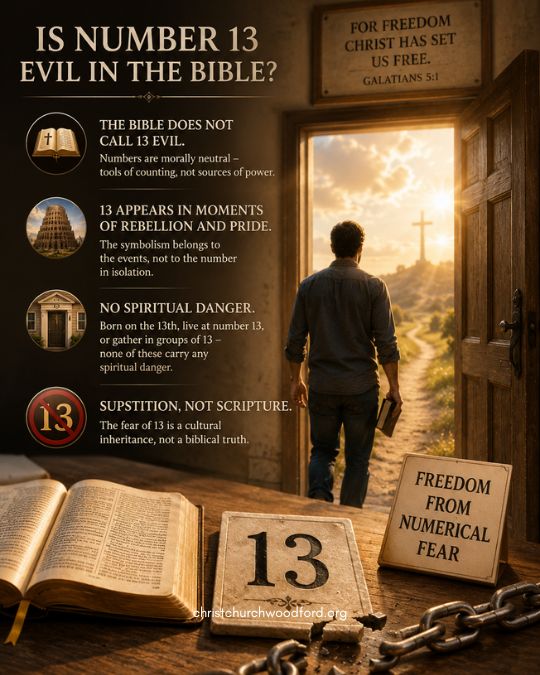
The Bible never calls the number 13 cursed. It never labels it as evil or spiritually dangerous. Numbers themselves are morally neutral objects — tools of counting, not sources of power.
What the Bible does give us is a set of narratives in which thirteen appears at specific moments of rebellion, pride, and human self-assertion. The symbolism is real, but it belongs to the events themselves, not to the number in isolation.
This matters pastorally. A person born on the thirteenth, who addresses a congregation of thirteen people, who lives at number thirteen — none of these things carries any spiritual danger. The superstition surrounding 13 is a cultural inheritance, not a biblical one. We would do well to hold the symbolism carefully without crossing into the fear that belongs to superstition.
As the Apostle Paul reminds us, “For freedom Christ has set us free; stand firm therefore, and do not submit again to a yoke of slavery” (Galatians 5:1). That freedom includes freedom from the bondage of numerical fear.
Spiritual Lessons Christians Can Learn From Number 13
1. Rebellion Against God Leads to Disorder
The kings of Genesis 14 served for twelve years and then rebelled in the thirteenth — and chaos followed. It always does.
When we step outside God’s order, we do not find the freedom we imagine. We find disorder, conflict, and consequences we did not anticipate. Rebellion against God leads to disorder is not a warning invented by religious authority — it is written into the fabric of human history and confirmed in the lives of people throughout Scripture and throughout time.
The spiritual lesson for us is personal before it is theological: Where am I, right now, asserting my own way over God’s design? What corner of my life has moved from the twelfth year into the thirteenth?
2. Pride Can Pull People Away From God
At Babel, the builders did not reject God in a single dramatic moment. They simply became so occupied with their own greatness that God became irrelevant to the project.
Pride works quietly. It does not usually announce itself. It simply crowds God out — slowly, politely, efficiently.
Pride can pull people away from God not through dramatic apostasy but through gradual self-sufficiency. When we stop praying because we feel capable, when we stop listening because we feel certain, when we stop depending because we feel secure — we are building our own version of Babel. And eventually, God will scatter what cannot stand.
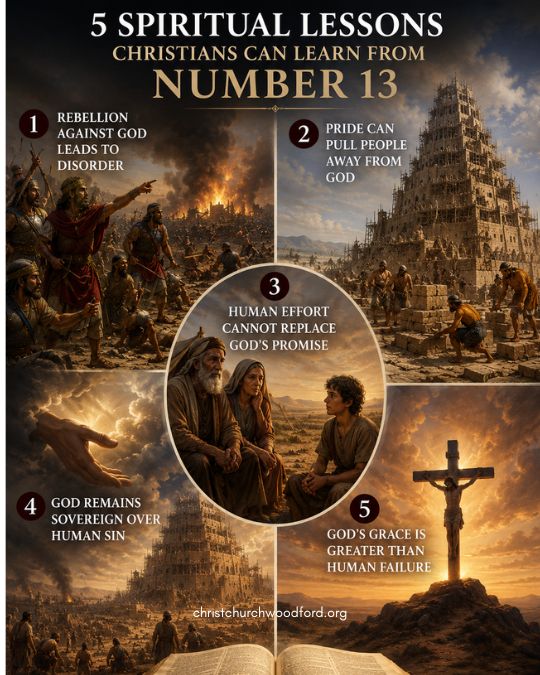
3. Human Effort Cannot Replace God’s Promise
Abraham and Sarah loved God and believed his promises. And yet, when the waiting became too long, they tried to manufacture the fulfilment themselves. The result was Ishmael — real, loved, but not the promise.
Human effort cannot replace God’s promise. This is not a condemnation of effort or planning or wisdom. It is a warning against substituting our strategies for God’s word.
There are things in your life that God has promised which you cannot engineer. Learn from Abraham: the lesson of the thirteenth year is that our timetable and God’s timetable are not always the same, and the gap between them is not an invitation to improvise. It is an invitation to trust.
4. God Remains Sovereign Over Human Sin
Every act of rebellion in these narratives — the kings who defied Chedorlaomer, the builders who raised Babel, the household of Abraham that reached outside God’s covenant — took place within a story that God was still writing. Not one moment of human sin surprised him. Not one act of pride derailed his purposes.
God remains sovereign over human sin. That is not a comfortable thing to hear if it makes us think sin does not matter — it does matter, enormously. But it is a profoundly stabilising truth for those of us who have watched the world, or our own hearts, spiral in directions that seem beyond redemption. No rebellion is beyond God’s governance.
5. God’s Grace Is Greater Than Human Failure
This is the note on which the biblical narrative of 13 ultimately resolves. The God who watched humanity rebel in the thirteenth year, who saw the pride of Babel and the striving of Abraham’s household, is the same God who sent his Son to walk into our rebellion and absorb its consequences.
God’s grace is greater than human failure. That is not a slogan. It is the cross. And it is the reason that even the most sobering themes in Scripture — rebellion, pride, disorder, self-sufficiency — are held within a story that ends not in condemnation but in redemption.
Frequently Asked Questions About Number 13 in the Bible
Can Number 13 Have a Positive Meaning?
Not directly. The number 13 in Scripture is consistently associated with rebellion, pride, and human resistance to God. That pattern is real and should not be softened.
But the broader biblical story always moves toward redemption. God blessed Ishmael despite his origins. God sustained Israel despite their wilderness rebellion. The positive meaning is not in the number itself — it is in the God who meets human failure with grace every time.
What is the first mention of 13 in the Bible?
The first mention of 13 in the Bible is Genesis 14:4: “For twelve years they had served Chedorlaomer, but in the thirteenth year they rebelled.” It is significant that the very first occurrence of this number in Scripture appears in the context of explicit, named rebellion. The biblical pattern is established from this opening moment.
Was Ishmael connected to number 13?
Yes. Genesis 17:25 records that Ishmael was circumcised at thirteen years old — the same moment God established his covenant with Abraham and promised that Sarah would bear Isaac. The number 13 here marks Ishmael’s position as the child of human effort rather than divine promise, symbolising the tension between flesh and faith. This is one of the clearest examples of the Bible meaning of number 13 in a narrative context.
What Does the Number 13 Signify in Hebrew?
In Hebrew thought, 13 carries an interesting duality. The Hebrew word echad (meaning “one” or “unity”) has a numerical value of 13 in gematria — leading some Jewish scholars to associate 13 with unity and love. However, the biblical narrative itself tells a different story. In the actual text of Scripture, 13 appears consistently at moments of rebellion and disorder. For Christians, the narrative weight of Scripture always takes priority over numerical calculation.
What Does the Number 13 Mean Spiritually?
Spiritually, the number 13 in the Bible points to the condition of the human heart apart from God — proud, self-directed, and resistant to divine authority. It is not a number to fear, but it is a number that invites honest self-examination. Where am I stepping outside God’s order? Where is pride quietly pulling me away from dependence on him? That is the spiritual question 13 puts to every reader.
What Does God Say About 13?
The Bible never singles out 13 with a direct divine pronouncement. God does not declare it cursed or blessed. What Scripture does show is that the moments marked by 13 — rebellion in Genesis 14, Ishmael’s circumcision in Genesis 17 — consistently draw God’s response of both judgment and grace. He does not ignore human rebellion, and he does not abandon rebellious people. That is the clearest thing God’s word shows us through the number 13.
Final Thoughts on the Biblical Meaning of Number 13
The biblical meaning of number 13 is not something to fear, and it is not something to dismiss. It is something to learn from.
What Scripture shows us, again and again, is the same stubborn tendency in the human heart — the desire to write our own story, set our own terms, and build our own order apart from God. Thirteen marks those moments. Not with a curse, but with a mirror.
And the mirror asks uncomfortable questions. Where am I asserting my will over God’s? Where is pride quietly doing its work in me? Where am I striving to produce what only God can give? Where have I moved, without even noticing, from the twelfth year into the thirteenth?
These are not questions that lead to condemnation. They are questions that lead to honesty. And honesty, in the hands of a gracious God, always leads somewhere good.
Because the same God who marked every act of human rebellion in Scripture also met every one of those moments with patience, pursuit, and redemption. He has never been defeated by human pride. He has never been surprised by human failure. And he has never stopped moving toward the people who turned away from him.
That is the final word. Not thirteen. Not rebellion. Not pride. Grace — stubborn, relentless, and greater than anything we could place against it.
If the number 13 teaches us anything, let it be this: our failure is never the end of the story. In God’s hands, it rarely even gets the last paragraph.